Grants Database

Objective 1 — Strengthen digital inclusion
By promoting the use of the Jamii platform instead of traditional paper ledgers, the project aims to enhance the digital literacy of funeral savings group (Iddir) members in Ethiopia. This will support their digital inclusion and sustained connectivity to their communities, enabling linkage to life-improving services.
Objective 2 — Build financial literacy and insurance readiness
By strengthening financial literacy and understanding of how insurance contributes to household resilience, the project aims to enable group members to access aTordable life insurance products that help protect livelihoods when a primary income-earner passes away.
Objective 3 — Test the value of improved healthcare access
By facilitating linkage to telemedicine services, the project will evaluate the impact of improved access to basic healthcare consultations on Iddir members and their households.
Objective 4 — Learning and Dissemination
By evaluating the results achieved, the project will produce insights that inform decisions on future scaling, as well as contributions to sector-wide learning through publication on the Digital Savings Group Hub and other relevant platforms.
Jamii has an established operational presence in Ethiopia and has recently strengthened its engagement with community-based saving groups. The regulatory and social environment for digital financial inclusion is considered conducive, supported by Jamii's existing networks and experience in the region. This project will enhance the digital inclusion of funeral savings groups (Iddirs) across Ethiopia, linking them to essential services including telemedicine and life insurance.
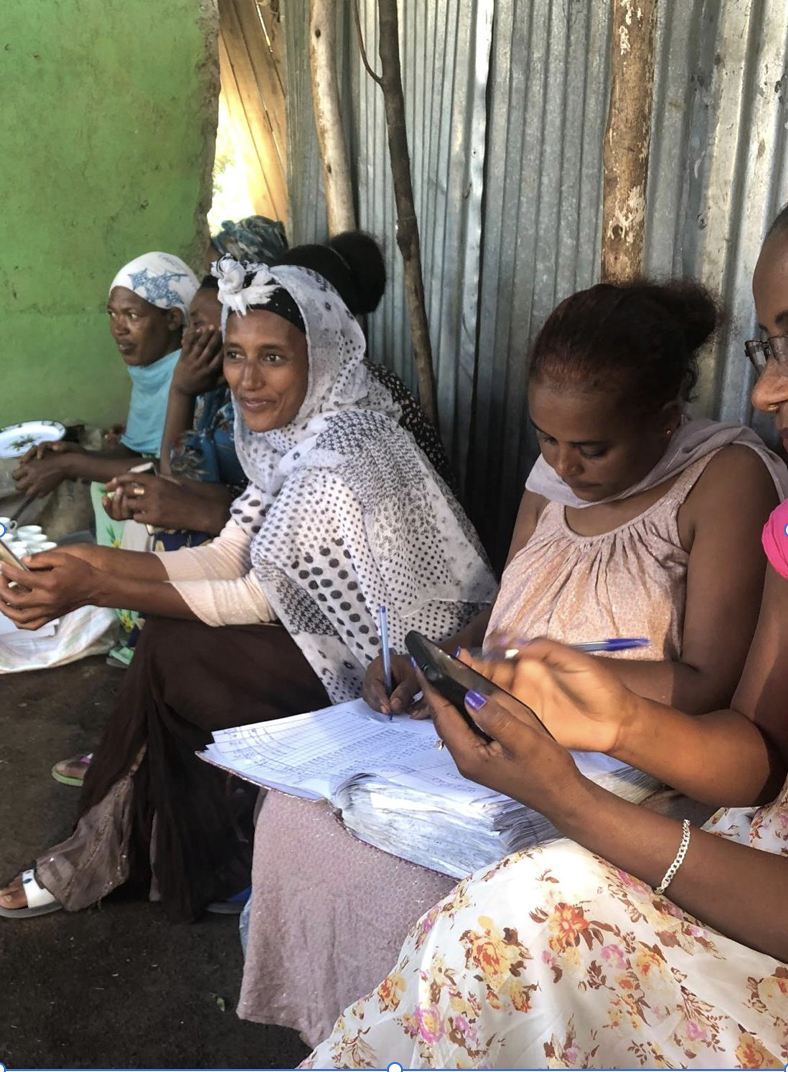

Digitalisation and linkage to health-related services of funeral savings groups in Ethiopia
To develop and test VSLF-based institutional loan packages and blended financing models with Opportunity Bank Uganda, creating structured pathways for smallholders to access affordable growth capital.
• To strengthen the governance, digital financial record-keeping, and loan management capacity of selected VSLFs, building their creditworthiness for engagement with formal financial institutions.
• To expand farmer enterprises and increase profitability among refugee and host-community smallholders through business planning, market linkage, and climate-smart agriculture support (Akeyo model and demonstration gardens).
• To generate, document, and disseminate evidence and learning on VSLF-based financing models to inform future scale-up within ADRA Denmark's broader financial inclusion and resilience portfolio.
The project will work with four selected VSLFs, chosen through a readiness assessment covering governance maturity, repayment discipline, digital record-keeping capacity, and business potential. Through a combination of blended finance design, VSLF governance strengthening, business planning, climate-smart agriculture support, and market linkages, S2S Phase 1 aims to establish feasibility and generate the evidence base needed to create structured and replicable financing pathways for smallholder farmers — particularly refugees, women, and youth.
The FAHU Foundation (FAHU) is partnering with ADRA Denmark and ADRA Uganda on a one-year Phase 1 initiative to evolve the Village Savings and Loan Federation (VSLF) model established under the REAL project (2024–2026) in Kyaka II and Rwamwanja refugee settlements1, Uganda. Building on demonstrated results — seven VSLFs managing a total loan portfolio of UGX 108 million, federating 70 Village Savings and Loan Associations (VSLAs) with approximately 2,400 members — S2S Phase 1 will take the model to its next generation by co-creating and testing institutional loan packages and blended financing mechanisms with Opportunity Bank Uganda Limited (OBUL).
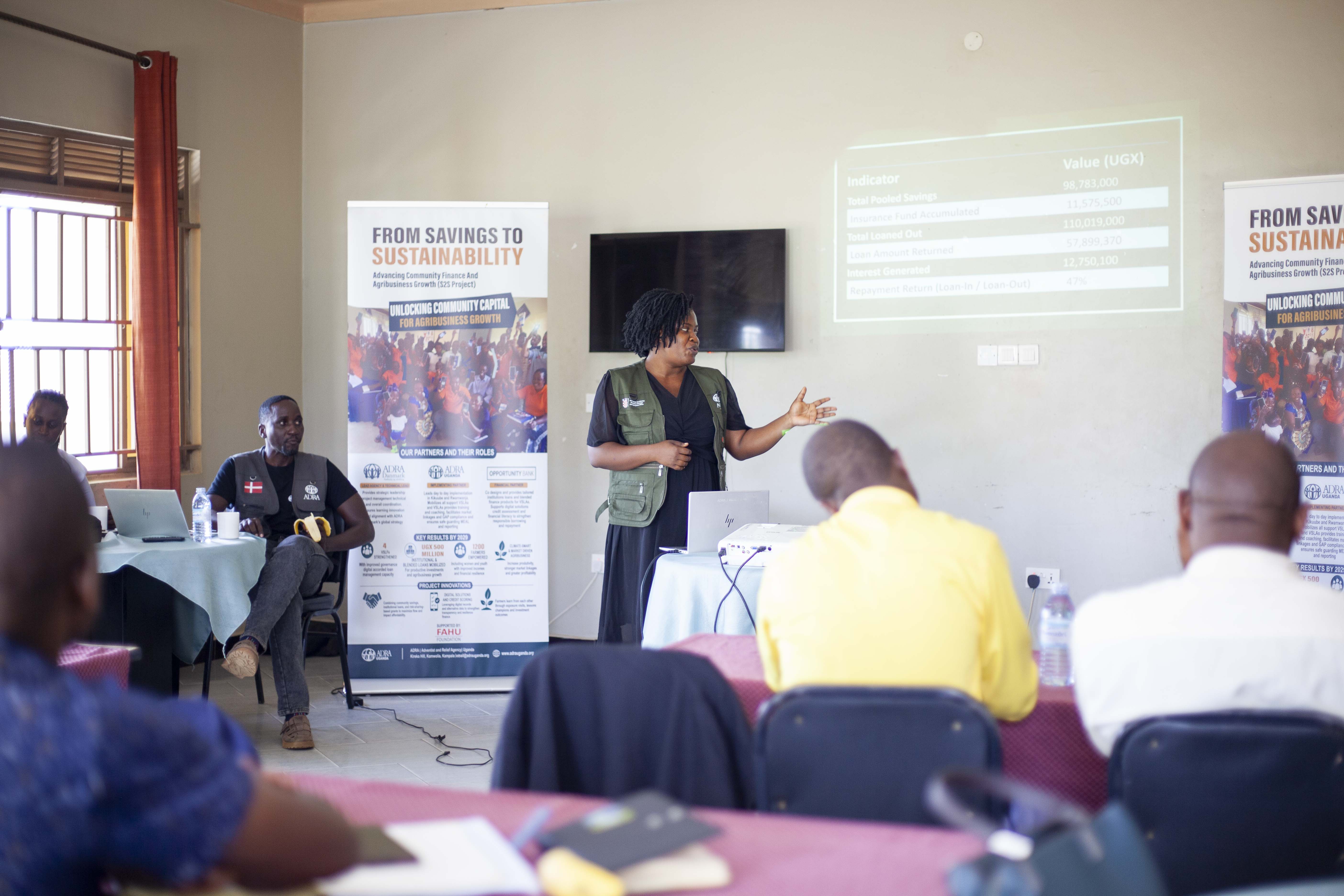
From savings to sustainability: Advancing community finance and Agribusiness Growth (S2S)
Increase savings and borrowing among 5,000 members across 200 savings groups through Akeyo’s group training, agricultural guidance, and input sales. Enable 100 agents to increase their income by implementing the Akeyo model. Systematically document the model to enable learning, inform future scale-up, and attract grant and investment funding
Building on the results and lessons from these two phases, Phase 3 of the project focuses on expanding outreach, strengthening systems and operational processes to enable future scale-up, and further integrating women’s empowerment into the model. A key objective is to validate the model’s long-term financial sustainability through increased revenue generation. In addition, the project will leverage Akeyo’s strategic partnership with VisionFund, which will provide loans to savings groups, with 40% allocated to Akeyo products and services.
The FAHU Foundation (“FAHU”) supported Akeyo Uganda Company Limited (“Akeyo”), through the Healthy Entrepreneurs Foundation, over an 18-month period covering Phase 1 (feasibility analysis) and Phase 2 (a 50-group pilot). The project aimed to develop an economically sustainable and scalable model for supporting savings groups, their agents, and their members in Buikwe and Kayunga districts in Uganda.
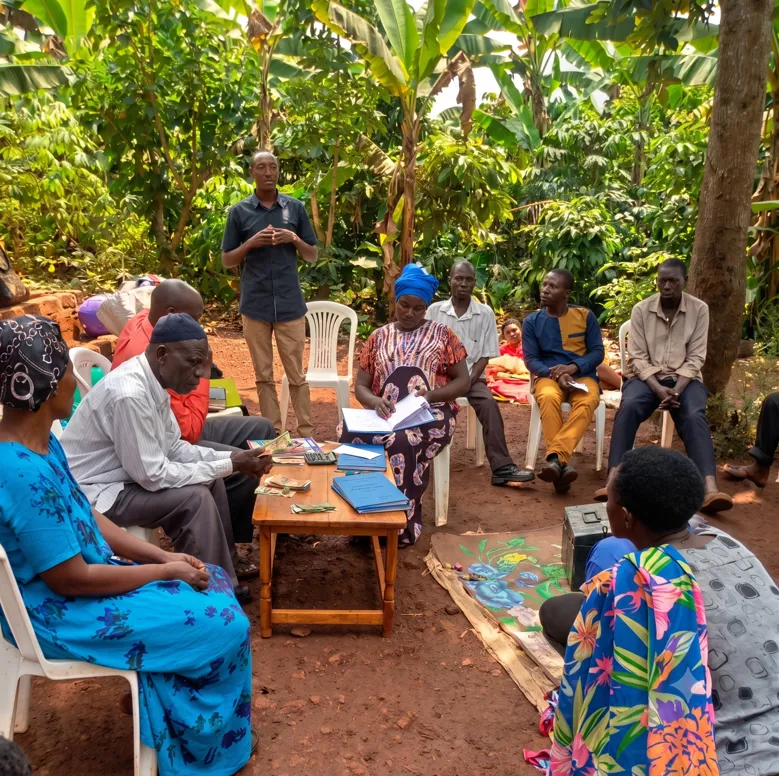
More & Better Groups, and a More Sustainable Model
The interventions aim to reduce poverty, enhance financial inclusion, improve the allocation of financial resources, lessen the financial burden of unexpected events to build crisis resilience, enhance access to healthcare, and improve health outcomes for savings group members.
The new project aims to digitalise an additional 500 savings groups (10,000 members), while maintaining lighter support of the current 10,000 active members and introducing bundled microinsurance and telemedicine services. This bundle combines hospital-cash, life, and funeral insurance with telemedicine solutions, addressing financial shocks while improving healthcare access. The initiative also seeks to explore and design an innovative financial solution for the “remaining protection gap” to further safeguard low-income communities. Publish articles on the DSG Hub and elsewhere.
Jamii.one Foundation successfully concluded the FAHU-funded project, “Digitising Savings Groups in Kenya to Increase Financial Resilience and Improve Digital Literacy.” This initiative empowered over 23,000 members of savings groups across Kenya, introducing them to digital tools with over 10,000 becoming active Jamii.one users. The project enhanced digital literacy and financial resilience by providing a digital platform for savings group record-keeping and underscored the demand for tailored microinsurance and healthcare solutions.

Digitizing savings groups and piloting microinsurance and telemedicine products in Kenya
Objective Global
Identify and locate mature VSLAs created by Dutabarane between 2009 and 2021 that are still active and can be organized into federations.
Specific objective 1
To collect updated data from VSLAs still active after x years closure of the projects that created them in order to draw inspiration from them for Develop future projects
Specific objective 2
To group together in federations the former VSLAs which have demonstrated maturity to train them in AGR and allow them to work at a level superior of their development.
Expected results
- 90% of VSLAs from old projects are identified in all 15 provinces of the intervention
- 85% of Village Agents from old projects are identified
- 100% of areas of old projects are visited.
- Collect the grievances and future prospects of these former VSLAs
The Danish Baptist/Dutabarane financial inclusion project—establishing savings group federations (VSLF) and providing financial literacy and social development training to village savings & loan associations (VSLA)—concluded in June 2024 with a budget surplus of $10.000. It was decided to reallocate the surplus funds for this new project—assessing the current status of the almost 10,000 VSLAs Dutabarane started across Burundi since 2009.
Baseline study on the status of graduated Savings Groups (VSLAs)
The overall goal of the DSG Hub project is to help actors across the savings group community make sound decisions about whether and how to digitize savings groups effectively. To inspire innovation, build a community of practice, and create a destination for anyone who is planning, implementing, developing technology for, or studying DSGs.
Operation and development of the DSG Hub as an online learning and community platform aimed at facilitating thoughtful, safe, and inclusive digitization of savings groups. The role of the FAHU Foundation as the Owner is that of a neutral initiator and custodian of the community with a long-term commitment to networking, cross-organizational learning, and improved collective capacity. The Role of CARE as the Facilitator is to be responsible for the function of a lean and increasingly member-led operation with strong focus on the core operation of the DSG Hub website (co-located resources) and the role of community facilitator (basic level of multidirectional communication, remote interaction). Co-located resources and a basic level of multidirectional communication amongst members are the ‘glue’ of the community. The Facilitator will coordinate a management committee as a decision-making body whose principal role is to engage and represent the users. The management committee will oversee the ongoing activities mentioned above and develop an actionable and relevant learning agenda for the future.
The DSG Hub is an online learning and community platform aimed at facilitating thoughtful, safe, and inclusive digitization of savings groups. The vision is a world with financial and digital inclusion for all, especially women, youth, and marginalized populations in underserved markets.

Digital Savings Group (DSG) Hub managed by CARE
Given its longstanding support of savings groups, the Foundation was curious to see how the groups in Chalatenango – one of FAHU's first projects -- had fared thirteen years after their initial grant. To do this, FAHU provided funding to carry out the evaluation. The mission was to learn how many groups were still saving and lending, how many groups disbanded, and understand the reasons for both outcomes.
The research consisted of three components:
- Qualitative research based on interviews with focus groups of local promoters
- Quantitative study of the groups trained by a sample of the group organizers.
- A brief video illustrating the principal findings of the research from the perspective of the trainers, group leaders, and others
In 2007, Oxfam utilized discretionary startup money plus additional project funding, first from Linked -- based in the United States -- and later from FAHU. Between 2008 and 2011 women organized 4,500 women (and a few men) into 330 groups. Most of the members women lived in villages in one of the poorest Departamentos (states) in El Salvador.

Evaluation Savings Groups in Chalatenango, El Salvador Thirteen Years Later
The expected impact of both phases of the project is that a total of 1250 members of 50 savings groups have increased their agricultural productivity through a sustainable and scalable delivery model.
The specific objectives are the following:
- A market and feasibility analysis is carried out. The analysis contains the business model including price points, willingness to pay, market size, and marketing and delivery channels.
- Increased productivity and income among 1250 savings group member
- A model of sustainable and scalable service delivery to savings groups developed and tested.
At least 15 technologies are selected (the catalogue), video technology isset up and test savings groups are identified.
The business model is described, including the role of savings groups,income streams and expected effects, based on interviews/workshop.
The business model is live tested and assessed: Willingness to pay, financial modelling and investment needs.
The catalogue is marketed to 2500 savings group members.
2500 savings group members are trained in new technologies.
Product and service offering for agents and farmers are iterated andadjusted. Incentive schemes and appropriate support for field agents are established.
Akeyo and HEF seek to develop an economically sustainable and thus scalable model to support savings groups and their members. The objective is to increase savings and agricultural productivity among savings groups and their members in Uganda. The hypothesis is that savings groups raise capital through savings and loans to pay for equipment and inputs, and videos show them how to use the equipment and inputs in order to increase productivity and income.

Making Savings Groups Grow
The primary goals of the Savings Groups component of the intervention that FAHU is supporting are to enable refugee and host farmers to self- or co-finance agricultural operations, to transition savings groups from paper to digital record-keeping (creating a digital footprint that will make credit more accessible to members/groups), and to document and share lessons learned from federating and digitizing savings groups in a refugee settlement.
- VSLA members receive training and support to form four Village Savings and Lending Federations (VSLF).
- 600 VSLF group members receive training on business planning, financial management, and entrepreneurship.
- 40 VSLAs and 4 VSLFs are trained to use digital recordkeeping tools instead of paper ledgers.
- Impact and potential of VSLFs in refugee settlements is assessed.
- Lessons learned and best practices for digitizing and federating savings groups in a refugee settlement are documented.
The Resilience Enhancement for Adapting Sustainable Livelihoods (REAL) project aims to address seven underlying causes of food insecurity: reduced distribution of food and cash, low agricultural production due to weather variability, gender inequality, insufficient access to land, water, and irrigation technology, limited market access, inadequate knowledge of post-harvest management and value addition, and lack of access to credit.

Resilience Enhancement for Adapting Sustainable Livelihoods (REAL)
The primary objectives of the project are to enhance the financial and digital literacy of savings group members by promoting the utilization of the Jamii.one Platform as an alternative to conventional paper ledgers; to ascertain and offer appropriate financial products such as life insurance, health insurance, and last-mile insurance catered to the specific needs of the savings group members; and to conduct user surveys to evaluate the advantages derived from utilizing the amii.one digital platform. Lastly, the intention is to share knowledge by publishing an article on the Digital Savings Group Hub and/or other platforms.
Implementation Phase
- Recruit and train 26 Community Digitization Promoters ('CDP's) (2 per dioces)
- Onboard an additional 80 groups (approximately 2000 savings group members) to the Jamii.One App
- Provide technical support to groups to further digital literacy so that there are aminimum of 10,000 active users
- Raise awareness about insurance and other financial products
- Monitor the linkage to formal financial service providers
Evaluation Phase
- Conduct an external survey of savings group members to evaluate the project.
- Assess the successes and challenges of digitizing savings groups in Kenya.
- Evaluate whether there were unintended results – positive or negative.
- Assess whether the livelihoods of the targeted beneficiaries were improved as a result of the project.
The pilot will determine interest and to find suitable partners for offering desirable products - such as health insurance, climate insurance, life insurance, banking services ( savings and loans), etc… The product/s will be based on members' needs and JamiiOne will negotiate with service providers to offer a good cost-effective product. The business model is that those providers will pay Jamii.One for access/data of the "new" customers to make it self-financed after the project period. The second phase will be onboarding the groups.

Digitising Savings Groups in Kenya to Increase Financial Resilience and Improve Digital Literacy.
Hiveonline aims to transform the way VSLAs operate in rural Mozambique by introducing a user-friendly digital application called VSLA.online. Supported by funding from the FAHU Foundation, this initiative seeks to strengthen recordkeeping and increase transparency among local savings groups.
- Onboard and train 89 existing savings groups with 13,000 members in the Nampula region of Mozambique by:
- Offer savings group functionality to 40,000 producers in cooperatives already formed, in parallel with their current onboarding of members onto myCoop under the existing Norges Vel sponsored rollout.
- Publish an article on the Digital Savings Group Hub website related to the benefits and learnings of this initiative
By building a credible financial history for each group, Hiveonline seeks to unlock formal credit and drive sustainability in some of the country’s most remote regions. Members can more easily see where their money is going, trust group calculations, and leverage their growing savings histories for credit and insurance.

Digitizing Savings Groups in Rural Mozambique with VSLA.online
The overall goal of the DSG Hub project is to help actors across the savings group community make sound decisions about whether and how to digitize savings groups effectively. To inspire innovation, build a community of practice, and create a destination for anyone who is planning, implementing, developing technology for, or studying DSGs.
Transition Phase Objectives and Deliverables
- Maintain the DSG Hub website and build interactive subpages for two “showcase” resources developed during phase I
- Maintain strong project management and community engagement
- Continue curating and creating compelling content for the DSG Hub
The DSG Hub is an online learning and community platform aimed at facilitating thoughtful, safe, and inclusive digitization of savings groups. The vision is a world with financial and digital inclusion for all, especially women, youth, and marginalized populations in underserved markets.
